
The common “Design Thinking first, then Agile” model is a dangerous oversimplification. The key to solving wicked problems is mastering the cognitive shift between two distinct operational modes: problem-finding (Design Thinking) and solution-building (Agile).
- Design Thinking is a structured process for de-risking innovation by ensuring you are solving a real, validated user problem.
- Agile is an iterative framework for efficiently building and delivering a solution once the problem is clearly understood.
Recommendation: Before your next project, consciously ask: “Are we in a problem-finding mode or a solution-building mode?” Your answer dictates which methodology to apply.
For any manager or student facing a “wicked problem”—a complex challenge with ambiguous requirements and interconnected factors—the landscape of methodologies can be bewildering. Buzzwords like Agile, Scrum, and Sprints promise speed and efficiency, leading many teams to jump straight into building solutions. They set up their backlogs, plan their iterations, and start coding, believing they are on the fast track to success. Yet, this is often a recipe for building a perfectly functional product that nobody actually needs or wants.
The common advice is to see Design Thinking and Agile as a simple, linear sequence: first, you use Design Thinking to find the problem, then you use Agile to build the solution. While not entirely wrong, this view misses the crucial underlying principle. The real challenge isn’t following a process; it’s about fostering a fundamental cognitive shift within a team. It’s about knowing when to embrace ambiguity and explore (the world of Design Thinking) versus when to drive for clarity and execute (the world of Agile).
But what if the true key to unlocking innovation and avoiding costly failures isn’t about choosing one over the other, but about methodically switching between these two powerful mindsets? This guide is not just another comparison. It is a methodological framework for managers and students to understand *when* to apply the problem-finding discipline of Design Thinking instead of defaulting to the solution-building efficiency of Agile. We will deconstruct the common failure points and provide a clear blueprint for navigating the ambiguity of wicked problems.
This article provides a structured approach to understanding the distinct roles of these two methodologies. We will explore the critical empathy phase, the mechanics of user discovery, the mental models that separate exploration from execution, and practical blueprints for rapid prototyping.
Summary: Solving Wicked Problems: A Guide to Design Thinking and Agile
- Why Skipping the Empathy Phase Leads to Product Failure?
- How to Ask Non-Leading Questions During User Discovery?
- Divergent or Convergent: Which Thinking Mode Do You Need Right Now?
- The “Solution Bias” Mistake That Design Thinking Prevent
- How to Iterate on Feedback Without Losing the Original Vision?
- Why Agile Methods Often Fail in Legacy Companies Within the First 6 Months?
- Why Paper Prototypes Are Better Than Code for Early Validation?
- From Idea to MVP in 5 Days: The Rapid Prototyping Blueprint for Students
Why Skipping the Empathy Phase Leads to Product Failure?
The Design Thinking process begins with empathy for a critical reason: it is the most effective tool for de-risking innovation. Teams that jump directly into solution-building are, in effect, making a high-stakes bet that their initial assumptions about the user’s problem are correct. This is a bet that rarely pays off. In fact, some research suggests 70% of projects fail precisely because they don’t deliver on their customer promises. This failure isn’t due to poor coding or inefficient project management; it’s a failure of understanding.
Skipping the empathy phase means you are designing in a vacuum. You build features based on internal stakeholder opinions, competitor analysis, or “gut feelings” rather than on validated user needs. This leads to products that, while technically functional, are met with indifference by the market. Users don’t adopt them because the product doesn’t solve a real, pressing problem in their lives. It’s a “solution” in search of a problem.
Empathy is not a “soft skill” or a feel-good exercise; it is a rigorous, data-gathering discipline. It involves structured interviews, observation, and immersion into the user’s world to uncover the unspoken needs and latent frustrations that users themselves may not even be able to articulate. World-renowned companies like Microsoft and IBM have embedded these practices into their development cycles to ensure they are building products grounded in reality. By investing time to deeply understand the user’s context, motivations, and pain points, you replace risky assumptions with actionable insights. This foundation is what separates products that get launched from products that get loved.
How to Ask Non-Leading Questions During User Discovery?
Effective empathy is built on the quality of your user discovery, and the quality of your discovery hinges on the questions you ask. The single biggest mistake teams make during user interviews is asking leading questions. A leading question contains an embedded assumption or a suggested answer, guiding the user toward a response you want to hear. Examples include: “Wouldn’t it be great if you could do X?” or “Is this process frustrating for you?” These questions generate confirmation bias, not genuine insight.
To conduct a proper user discovery, you must become a neutral investigator of past behavior, not a salesperson for future ideas. The goal is to uncover stories and workflows, not to validate a preconceived solution. The Jobs-to-be-Done (JTBD) framework provides an excellent structure for this. It focuses on understanding the “job” a user is trying to accomplish. To do this, your questions should be open-ended and focused on specific, past experiences.
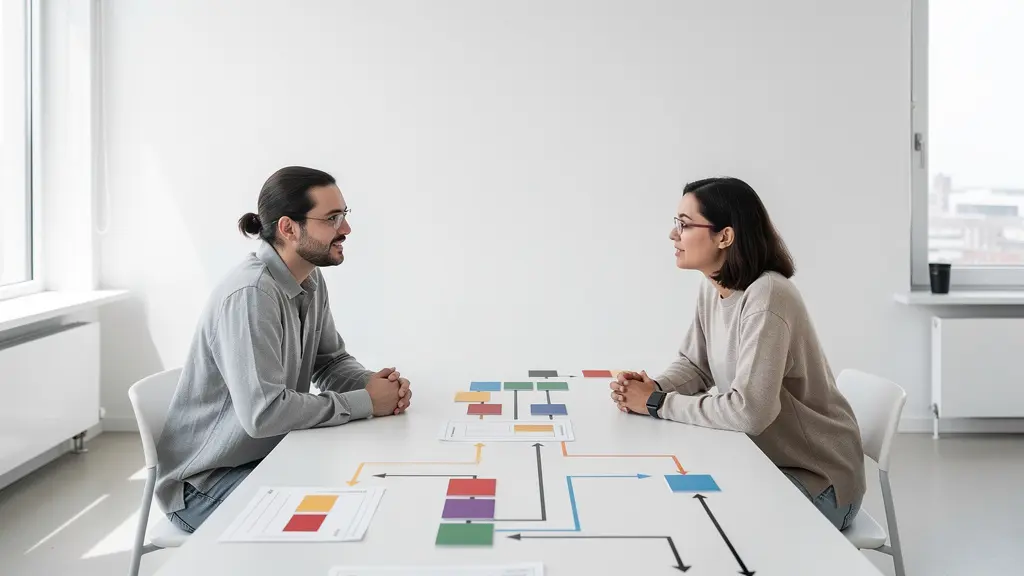
Instead of asking hypothetical questions, use prompts that elicit stories. Here are some powerful, non-leading questions to guide your discovery sessions:
- “Walk me through the last time you tried to [accomplish the job]. What did that look like?”
- “What else did you try before or after that approach?”
- “Tell me about the most frustrating part of that experience.”
- “Show me how you are currently handling this situation.”
These questions force the user to recall actual events and behaviors, providing a rich, contextual understanding of their struggles and workarounds. By focusing on what people *have done* rather than what they *might do*, you gather objective data that forms a solid foundation for defining the real problem to be solved.
Divergent or Convergent: Which Thinking Mode Do You Need Right Now?
The core of the “cognitive shift” between Design Thinking and Agile lies in understanding two distinct modes of thought: divergent and convergent thinking. A team’s inability to recognize which mode is required at which stage is a primary source of friction and failure. Projects stall when teams try to converge too early or diverge when a decision is needed.
Divergent thinking is the mode of exploration. Its motto is “more is more.” The goal is to generate a wide array of options, ideas, and possibilities without judgment. This is the heart of the “Empathize” and “Ideate” phases of Design Thinking. It’s about quantity over quality, exploring wild ideas, and mapping out the entire problem space. In this mode, criticism is suspended, and every idea is given a hearing. This is crucial for ensuring you don’t prematurely fixate on a single, obvious (and likely wrong) solution.
Convergent thinking, on the other hand, is the mode of decision-making. Its motto is “less is more.” The goal is to systematically analyze, evaluate, and select the best option from the possibilities generated during the divergent phase. This is the essence of Agile sprints, where a team must commit to a specific set of features in a backlog and execute them. It requires critical evaluation, logical analysis, and making trade-offs based on clear criteria like feasibility, viability, and desirability. This is where you bring judgment and focus back into the process.
A classic failure pattern is a “brainstorming” session where every new idea is immediately shot down with “that will never work.” This is a team trying to converge while they should be diverging. Conversely, an Agile team that constantly re-opens debates about core features during a sprint is a team diverging when they should be converging. Recognizing which mode is needed is a critical leadership skill.
The following table outlines the key indicators for each mode, helping your team identify which one is needed right now.
| Divergent Thinking Mode | Convergent Thinking Mode |
|---|---|
| Generate multiple ideas | Select best solution |
| Explore possibilities | Make decisions |
| No judgement zone | Critical evaluation |
| Quantity over quality | Quality and feasibility |
| Creative brainstorming | Systematic analysis |
The “Solution Bias” Mistake That Design Thinking Prevent
The most dangerous and pervasive cognitive trap in product development is “solution bias,” also known as “solutioneering.” It’s the natural human tendency to jump immediately to solutions before fully understanding the problem. As a manager, you’ve seen it a hundred times: a user mentions a minor inconvenience, and within minutes, the team is designing a new button, a new screen, or a whole new feature. This is where Agile, when misapplied, can accelerate you in the wrong direction.
Agile is a solution-building framework. It is exceptionally good at taking a defined problem (a user story in a backlog) and breaking it down into executable chunks. However, it has no built-in mechanism to question whether the user story itself is the *right* thing to build. This is the critical gap that Design Thinking fills. As design expert Jeff Gothelf notes:
While Agile is an approach to problem solving, design thinking is an approach to problem finding.
– Jeff Gothelf, Design expert and co-author of Lean UX
Design Thinking is, in essence, a structured methodology to combat solution bias. The “Empathize” and “Define” phases force a team to slow down and fall in love with the problem, not the solution. By investing time in user interviews, observation, and synthesis, the team develops a deep, shared understanding of the user’s actual pain points. The outcome of this phase is not a feature list, but a well-framed problem statement—a clear, concise articulation of the user’s need. Only when this problem statement is agreed upon and validated does it make sense to start ideating solutions and eventually move into an Agile workflow.
Your Action Plan: Detoxing from “Solutioneering”
- Problem Definition: For every new feature request, rigorously apply the “5 Whys” technique to uncover the root problem behind the proposed solution.
- Solution-Free Brainstorming: Conduct “Problem-Only Brainstorming” sessions where the team is forbidden from mentioning any solutions and must only describe the user’s struggle.
- Assumption Mapping: Before designing anything, force the team to explicitly write down all the assumptions they are making about the user and the problem.
- User Story Reframing: Rewrite user stories from a solution-focused format (“As a user, I want a button…”) to a problem-focused one (“As a user, I’m trying to achieve [goal], but [obstacle] stops me.”).
- Sacrificial Concepts: Intentionally create a “sacrificial” prototype of a flawed solution to elicit deeper, more honest feedback about the underlying problem from users.
How to Iterate on Feedback Without Losing the Original Vision?
Both Design Thinking and Agile are built on the principle of iteration and feedback. However, collecting feedback is easy; knowing how to act on it is hard. A common failure pattern is “feedback whiplash,” where a team frantically changes direction with every new piece of user input, eventually losing sight of the original problem they set out to solve. The product becomes a Frankenstein’s monster of disconnected features, trying to be everything to everyone and ultimately serving no one well.
The antidote to this is a strong, well-defined product vision. A vision is not a feature list; it is a guiding north star that articulates the fundamental problem being solved, the target user, and the core principles of the user experience. It acts as a filter through which all feedback must pass. Before implementing any change based on feedback, the team must ask: “Does this align with our vision?”
A successful approach is to implement a “feedback triage” framework. This involves categorizing all incoming user input into three buckets:
- Signal: Feedback that aligns with the product vision and reveals a genuine opportunity or a critical flaw in the current execution. This is the feedback to act on.
- Noise: Feedback that represents outlier opinions, personal preferences, or requests that contradict the core vision. This feedback should be acknowledged but deliberately ignored.
- Usability Hiccups: Feedback that points out clear flaws in the execution (e.g., a confusing button, a slow-loading page) but doesn’t challenge the core concept. These are typically quick fixes.

To make this work, the vision must be explicit. A robust vision document should include a core problem statement, key user principles, and even “anti-goals”—a list of things the product will explicitly *not* do. This document becomes the team’s constitution, allowing them to iterate on execution details (usability hiccups) and strategic insights (signal) without getting derailed by noise.
Why Agile Methods Often Fail in Legacy Companies Within the First 6 Months?
Many established, legacy companies attempt an “Agile transformation” with great enthusiasm, only to see it fizzle out within six months. The teams go through the motions—daily stand-ups, two-week sprints, retrospectives—but nothing fundamentally changes. They are practicing “Cargo Cult Agile”: meticulously copying the rituals of successful Agile teams without understanding the underlying principles. The result is often just a faster way of building the wrong products.
This failure typically stems from a deep-seated cultural resistance to the core tenets of Design Thinking, especially empathy and problem-finding. In many large organizations, strategy is dictated from the top down. Product roadmaps are driven by executive mandates, sales team demands, or what the competition is doing. The idea of empowering a team to spend weeks simply “understanding the user” before any code is written can seem inefficient and counter-cultural.
Without a genuine problem-finding phase, the Agile machine is fed a backlog of features based on unvalidated assumptions. The team sprints efficiently, delivering feature after feature, but since these features don’t solve real user needs, they fail to gain traction. Metrics don’t improve, revenue doesn’t grow, and executives soon question the value of the “Agile transformation.” The true failure, however, was not with Agile itself, but with the lack of a user-centric problem definition process to precede it. Design-led companies, which embed this philosophy, see tangible results; as evidenced by the fact that 50% of design-led companies report more loyal customers.
Why Paper Prototypes Are Better Than Code for Early Validation?
In the early stages of exploring a solution, the goal is not to build a functional product; it is to learn as quickly and cheaply as possible. This is where many teams make a critical mistake: they invest weeks or months building a high-fidelity, coded prototype or MVP. The problem with this approach is twofold. First, it is slow and expensive. Second, and more importantly, it inhibits honest feedback.
When you present a polished, coded prototype to a user, they tend to focus on superficial details like button colors, fonts, or minor usability issues. They are also less likely to give brutally honest feedback, as they can see the significant effort that has gone into building it. They don’t want to hurt your feelings by saying, “I would never use this.” As Jeff Gothelf points out, without a clear problem understanding, this leads to teams working on the wrong things:
Without a clear understanding of the problem, product managers optimize backlogs of work based on gut instinct and subjective preference from stakeholders.
– Jeff Gothelf, Lean vs Agile vs Design Thinking
This is why paper prototypes are a superior tool for early validation. A paper prototype is a simple, hand-drawn sketch of the user interface. Its power lies in its low fidelity. Because it is clearly a rough draft, users feel more comfortable critiquing the core concept. They are not afraid to say, “This whole approach doesn’t make sense to me.” This is exactly the kind of high-level, concept-killing feedback you need to hear early on, before a single line of code is written.
Testing with paper prototypes allows you to validate the fundamental value proposition of your idea in a matter of hours, not weeks. You can iterate on the spot, redrawing a screen based on feedback during the interview itself. This rapid loop of “build-test-learn” is the fastest way to discard bad ideas and refine good ones, ensuring that by the time you do start coding, you are building on a validated foundation.
Key Takeaways
- The choice between Design Thinking and Agile is not a one-time decision but a constant cognitive shift between problem-finding and solution-building.
- Skipping the empathy phase is the most common cause of product failure; it is a risk-mitigation discipline, not a soft skill.
- Mastering divergent (exploratory) and convergent (decisional) thinking modes is critical to avoid stalling projects or building the wrong thing efficiently.
- Paper prototypes are a more effective tool for early concept validation than coded prototypes because they elicit more honest, high-level feedback.
From Idea to MVP in 5 Days: The Rapid Prototyping Blueprint for Students
For students, especially those in business, design, or engineering programs, the ability to rapidly take an idea and turn it into a testable concept is an invaluable skill for both academic projects and future careers. The principles of Design Thinking and rapid prototyping can be condensed into a powerful 5-day sprint format, perfect for a class project or a hackathon. This blueprint provides a structured way to experience the full problem-finding and solution-building cycle.
The goal is not to build a perfect, scalable product, but to generate a validated prototype and a compelling story for your portfolio. The campus environment is a perfect laboratory for this, providing easy access to a diverse user base. Here is a practical 5-day blueprint for students:
- Day 1: Define the Problem. Choose a problem space relevant to student life (e.g., finding study groups, campus dining, course registration). Crucially, create a “not-to-do” list to narrow your focus to a single, specific pain point.
- Day 2: Guerrilla Research. Get out of the classroom. Conduct short, informal interviews in the cafeteria, library, or student union. Use the non-leading questions from earlier to understand how students currently deal with the problem.
- Day 3: Ideate and Paper Prototype. Based on your research, brainstorm a wide range of solutions (divergent thinking). Then, select one core idea and create simple paper prototypes of the key screens or interactions (convergent thinking).
- Day 4: Build a Minimum Testable Prototype. Use simple tools (like Figma, InVision, or even just linked Google Slides) to create a clickable, digital version of your paper prototype. This is your Minimum Viable Product (MVP) for testing.
- Day 5: User Testing and Portfolio Documentation. Test your clickable prototype with 3-5 new students. Record their feedback. Finally, document your entire process—from initial problem statement to final feedback—in a concise case study for your portfolio.

This compressed cycle teaches the most important lesson: the value of grounding solutions in validated user needs. It demonstrates an ability to move from ambiguity to clarity, a skill highly sought after by employers.
Ultimately, the debate between Design Thinking and Agile is a false choice. They are two different toolsets for two different stages of a journey. The truly effective manager or student is not an expert in one or the other, but is adept at recognizing which mode is required for the challenge at hand. The next time you begin a project, resist the urge to immediately open a project management tool. Instead, start with a simple question: “Are we still trying to understand the problem, or are we ready to start building the solution?” Your answer will be the most reliable guide you have.