
Achieving a 20% cost reduction isn’t about a blanket “digital transformation,” but the surgical application of specific digital tools to your most expensive operational bottlenecks.
- Digital twins can preemptively identify cost-inefficient suppliers before disruptions or tariffs hit.
- Blockchain verification can cut authentication costs by over 70% while nearly eliminating fraud in high-value chains.
Recommendation: Instead of a massive overhaul, start by modeling one high-cost area—like last-mile delivery or inventory holding—to prove ROI with a targeted digital solution.
For any Operations Manager, the pressure is relentless. Shipping costs are climbing, customer expectations are soaring, and every unforeseen disruption sends shockwaves through your budget. The common refrain from consultants and tech vendors is “digitalize your supply chain.” But this advice is often vague, promising a universal cure without providing a precise prescription. The reality is that a scattergun approach to digitalization is a fast track to burning capital with little to show for it. You don’t need more software; you need better returns.
The true path to significant cost reduction—the kind that gets you noticed—isn’t about buying into the hype of “Industry 4.0.” It’s about acting with the precision of a surgeon. It’s about diagnosing your most acute points of financial pain, from inventory errors to last-mile inefficiencies, and applying a specific, proven digital tool to solve that exact problem. It’s about moving from abstract concepts to ROI-driven implementation. Forget transforming everything at once. The key is to find the one lever that, when pulled, creates a disproportionate financial impact.
This guide abandons the generic overview. Instead, it provides a series of focused playbooks. Each section tackles a critical operational bottleneck and details how a specific digital technology can be deployed not just for efficiency, but for a measurable and significant reduction in cost. We will explore how to predict disruptions before they happen, how to verify provenance without exorbitant costs, and how to make data-driven decisions that directly impact your bottom line.
To navigate this strategic approach effectively, we have broken down the core challenges and their digital solutions. This structure will allow you to pinpoint the areas most relevant to your operations and understand the specific actions required to generate ROI.
Summary: A Manager’s Guide to Digital Logistics ROI
- Why Digital Twins Are Essential for Predicting Supply Chain Disruptions?
- How to Use Blockchain to Verify Provenance in Luxury Supply Chains?
- 3PL or In-House Digital Fleet: Which Scales Better for Mid-Sized Retailers?
- The IoT Vulnerability That Could Paralyze Your Entire Warehouse
- How to Cut Last-Mile Delivery Times by 30% Using Route Optimization AI?
- The Inventory Error That Bankrupts 30% of Growing E-Commerce Brands
- How to Set Dynamic Reorder Points Based on Lead Time Variability?
- Preventing Stockouts: How Predictive Modeling Saves Retailers During Peak Seasons?
Why Digital Twins Are Essential for Predicting Supply Chain Disruptions?
In today’s volatile market, waiting for a disruption to happen is no longer a viable strategy. The operational and financial damage is simply too great. A recent report highlighted a staggering increase, with 90% more supply interruptions recorded since 2020. This is where a digital twin moves from a “nice-to-have” technology to an essential tool for risk mitigation and cost control. It’s a living, virtual model of your entire supply chain, allowing you to run “what-if” scenarios without real-world consequences.
Instead of reacting to a tariff increase or a port closure, you can simulate its impact weeks or months in advance. This allows you to see which suppliers will become cost-inefficient, which routes will become bottlenecks, and where inventory will be at risk. It transforms risk management from a reactive, damage-control function into a proactive, strategic advantage. The goal is to make decisions based on data-driven foresight, not hindsight.

The practical application of this is profound. Consider a European electronics firm that used a digital twin to model various tariff scenarios. The simulation revealed a critical cost-inefficiency threshold; if certain tariffs were implemented, 30% of their supplier network would immediately become unprofitable. This predictive insight allowed them to proactively re-source and re-negotiate contracts *before* the tariffs became a reality, saving millions in potential losses and avoiding massive operational disruption. This isn’t just prediction; it’s prescriptive analysis that directly protects your margins.
How to Use Blockchain to Verify Provenance in Luxury Supply Chains?
In the luxury goods sector, provenance is everything. Authenticity is the brand promise, and any doubt can erode value instantly. However, traditional authentication methods involving third-party experts and cumbersome paperwork are both incredibly expensive and slow. They create significant operational friction and are surprisingly fallible. Blockchain offers a radically different approach: creating an immutable, transparent, and real-time digital ledger of a product’s journey from creation to customer.
By tokenizing a physical item, you create a digital passport that cannot be counterfeited or altered. Every handover, every customs check, and every verification is recorded on the chain, accessible to brand, retailer, and even the end consumer via a simple QR code scan. This doesn’t just fight counterfeiting; it dramatically reduces the overhead associated with verification and builds unparalleled consumer trust. The ROI is not just in fraud prevention, but in operational streamlining.
The financial argument for this surgical application of technology is compelling. A direct comparison shows that while traditional methods are costly and slow, blockchain provides superior results for a fraction of the cost, as a recent analysis of authentication costs demonstrates.
| Authentication Method | Annual Cost per 1000 Items | Fraud Detection Rate | Processing Time |
|---|---|---|---|
| Traditional Third-Party Authentication | $45,000-60,000 | 75-80% | 3-5 days |
| Blockchain Verification | $12,000-18,000 | 95-98% | Real-time |
| Manual Documentation | $30,000-40,000 | 60-65% | 7-10 days |
Implementing such a system moves from abstract idea to a clear plan with the right framework. It’s about integrating technology to create a more secure and efficient chain of custody.
Action Plan: Implementing Blockchain for Product Authentication
- Integrate blockchain with existing inventory management systems to create immutable product records from manufacturing origin.
- Implement QR code or NFC chip technology on products to enable smartphone-based verification by customers and partners.
- Establish smart contracts for automated authentication triggers at each supply chain checkpoint.
- Create incentive programs for small-scale suppliers using simple mobile apps for data entry.
- Connect blockchain verification to insurance providers to negotiate for reduced fraud premiums based on the higher security.
3PL or In-House Digital Fleet: Which Scales Better for Mid-Sized Retailers?
For a mid-sized retailer, the choice between outsourcing logistics to a Third-Party Logistics (3PL) provider or investing in an in-house digital fleet is a critical strategic decision. A 3PL offers immediate scale and flexibility with minimal capital outlay, but you sacrifice control and can be exposed to unpredictable surcharges. An in-house fleet provides maximum control and brand consistency but requires significant upfront investment and operational expertise.
The modern, data-driven answer is not necessarily one or the other, but knowing precisely when to transition. Digitalization provides the tools to make this a calculated decision rather than a gut feeling. By using digital twin technology, you can model the performance of your current 3PL partners against the projected costs and efficiencies of a hypothetical in-house fleet. This allows you to establish data-driven “graduation triggers”—specific metrics (like volume, delivery density, or 3PL cost-per-package) that signal the exact moment when bringing logistics in-house becomes the more profitable option.
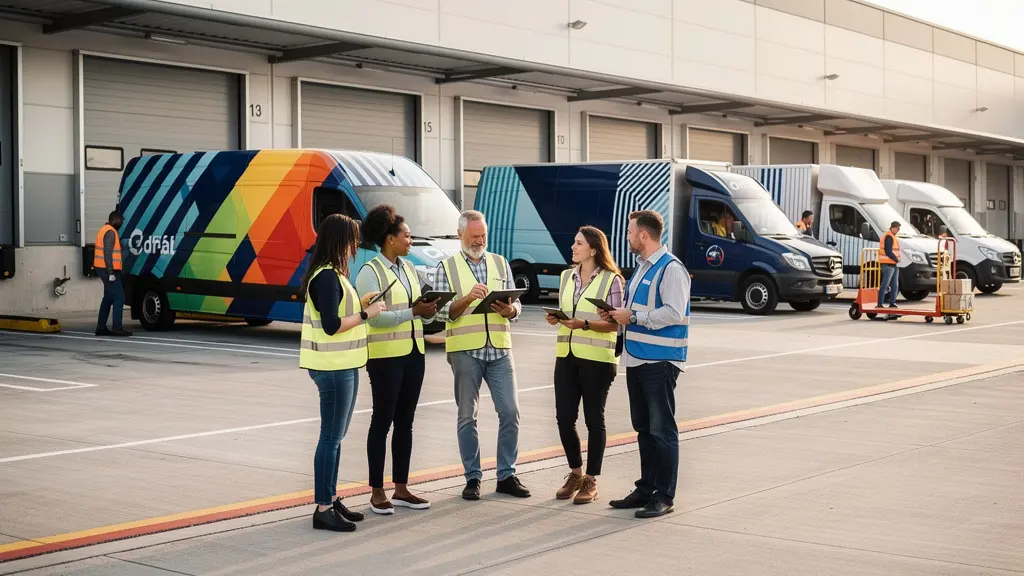
This isn’t just theoretical. One OEM struggling with last-mile costs implemented this exact approach. As noted in a McKinsey analysis of end-to-end supply chain growth, by using automated digital-twin capabilities to monitor carrier performance, the company was able to reduce last-mile transportation costs by 5 percent. The system provided the hard data needed to justify a gradual, targeted transition from outsourced to owned logistics, ensuring each step was ROI-positive.
The IoT Vulnerability That Could Paralyze Your Entire Warehouse
The “smart warehouse” is a marvel of efficiency, with thousands of Internet of Things (IoT) devices—from handheld scanners to autonomous guided vehicles (AGVs)—all communicating to orchestrate the flow of goods. But this hyper-connectivity creates a new, often overlooked, attack surface. A single compromised temperature sensor or a hacked sorting system can be a gateway for a malicious actor to bring your entire operation to a standstill, creating a “cyber-physical” crisis.
This isn’t a typical IT breach; it’s an operational catastrophe. Imagine your inventory data being held for ransom, or your AGVs being instructed to collide with each other. The cost is not just in downtime but in physical damage, data corruption, and a complete loss of operational control. Securing these devices isn’t just an IT issue; it’s a fundamental pillar of operational continuity. The first step is isolating critical systems and having manual override protocols ready. Your response plan must include deploying air-gapped backups for inventory tracking and immediately initiating forensic logging to trace the attack vector.
However, the very connectivity that creates the risk also holds the key to unprecedented resilience. When secured properly and integrated with AI, this network of sensors creates a “closed-loop intelligence” system that can autonomously detect and respond to disruptions far faster than any human team. As experts from MIT and Rutgers noted in the Supply Chain Management Review:
By 2030, this type of closed-loop intelligence could reduce average disruption duration by 40%, fundamentally altering how we define ‘recovery’
– MIT and Rutgers Research Teams, Supply Chain Management Review
The takeaway is clear: ignoring IoT security is an invitation for disaster, but mastering it is a pathway to a more intelligent, self-healing supply chain that minimizes the financial impact of any disruption, internal or external.
How to Cut Last-Mile Delivery Times by 30% Using Route Optimization AI?
The last mile is consistently the most expensive and complex part of the delivery journey. It’s also where customer expectations are highest and brand reputations are won or lost. Simply using a standard GPS for routing is no longer sufficient. Achieving a significant, 30% reduction in delivery times—and the associated costs in fuel, labor, and vehicle wear—requires a more sophisticated approach: route optimization AI.
This technology goes far beyond finding the shortest path. It’s a cognitive computing system that analyzes thousands of variables in real time: traffic patterns, delivery windows, vehicle capacity, driver schedules, and even weather forecasts. It doesn’t just plan a route; it orchestrates a dynamic delivery network. It’s no surprise that a 2023 IBM survey found that 46% of executives prioritize AI/cognitive computing as a key investment area. They see the clear ROI in turning a chaotic last mile into a predictable, optimized system.
Case Study: DHL’s AI-Powered Peak Demand Management
DHL Supply Chain provides a masterclass in applying this principle. To manage extreme demand fluctuations during peak seasons, the company uses machine learning to analyze historical order patterns. Crucially, the system doesn’t just look at internal data; it flags and incorporates external factors that influence customer behavior, such as weather events and economic indicators. The result is a highly accurate forecast that allows DHL to prepare its workforce and fleet, efficiently managing massive peaks without compromising service levels. It’s a clear demonstration of using AI not just for routing, but for predicting and shaping operational reality.
By processing vast datasets to find the optimal sequence and path for every single delivery, AI can consolidate routes, increase the number of stops per hour, and dramatically reduce time on the road. This translates directly into lower fuel consumption, reduced labor costs, and a higher asset utilization rate for your fleet, all while improving customer satisfaction with faster, more reliable deliveries.
The Inventory Error That Bankrupts 30% of Growing E-Commerce Brands
For a growing e-commerce brand, cash flow is oxygen. And the single biggest drain on cash flow is often hidden in plain sight: inventory. The most dangerous inventory error isn’t just having too much or too little stock; it’s having “phantom inventory”—items your system says you have, but which are physically unavailable. This often happens due to unprocessed returns, mis-scans, or theft, and it leads to a cascade of costly problems: overselling, cancelled orders, angry customers, and expensive expedited shipping to fix mistakes.
This problem is becoming more acute as labor costs rise. With a reported 30% increase in warehousing wages in the U.S. between 2020 and 2024, relying on manual cycle counts to correct these errors is becoming prohibitively expensive and is always a step behind. The solution is to use AI to make your inventory system proactive instead of reactive. This involves deploying a combination of IoT sensors on high-velocity items and anomaly detection algorithms.
The system works by continuously comparing the digital record with real-world movement. When an AI-powered system detects a discrepancy—for example, an item is marked as “returned” in the system but its IoT sensor hasn’t moved from the customer’s location—it can automatically trigger a reconciliation workflow. This prevents phantom inventory from ever entering the “available to sell” stock. It automates the audit process, focusing human effort only where it’s truly needed and turning inventory management from a major cost center into a source of operational intelligence.
How to Set Dynamic Reorder Points Based on Lead Time Variability?
Traditional inventory management often relies on static reorder points: “When stock of Item X hits 50 units, order 500 more.” This simple rule works in a perfectly stable world, but in a real-world supply chain plagued by supplier delays, shipping volatility, and demand spikes, it’s a recipe for disaster. It leads to a constant, costly cycle of holding excessive safety stock (tying up cash) and suffering from stockouts (losing sales).
The digital, ROI-focused approach is to replace static rules with dynamic, AI-based reorder points. An intelligent system doesn’t just look at current inventory levels. It continuously analyzes lead time variability from your suppliers, monitors real-time sales data, and even factors in external variables like upcoming holidays or forecasted weather events. Instead of a fixed number, the reorder point becomes a moving target, calculated daily to find the perfect balance between inventory holding costs and stockout risk.
The performance difference between these two methodologies is not subtle; it is a fundamental shift in operational and financial efficiency. The data shows a clear winner when moving from a static to a dynamic system, providing a strong business case for investment.
As a comparative analysis of reorder methods clearly shows, the benefits in reduced stockouts and optimized inventory are substantial.
| Reorder Method | Stockout Frequency | Average Inventory Holding | Response to Disruption |
|---|---|---|---|
| Static Reorder Points | 12-15% annually | 35-40 days of supply | 5-7 days lag |
| Dynamic AI-Based System | 3-5% annually | 22-25 days of supply | Real-time adjustment |
| Hybrid Model with Supplier Integration | 2-3% annually | 18-20 days of supply | Predictive (before disruption) |
By implementing a dynamic system, you are essentially buying certainty. You reduce the capital frozen in safety stock, cut stockout-related lost revenue by over 60%, and create a more resilient supply chain that adjusts automatically to changing conditions.
Key Takeaways
- Digitalization ROI comes from surgical application on specific bottlenecks, not broad transformation.
- Predictive tools like digital twins turn risk management from a reactive cost into a proactive, profit-protecting strategy.
- Automating trust and verification with technologies like blockchain can yield over 70% cost savings compared to traditional methods.
Preventing Stockouts: How Predictive Modeling Saves Retailers During Peak Seasons?
The pressure to deliver has never been higher. Research shows that more than 90% of US consumers now expect fast, two-to-three-day delivery as a standard. During peak seasons, this expectation meets a surge in demand, creating a perfect storm for stockouts. A stockout is more than a lost sale; it’s a broken customer promise that can permanently damage brand loyalty. Predictive modeling is the strategic defense against this, moving beyond simple forecasting to anticipate needs across the entire supply chain.
Effective predictive modeling doesn’t just ask, “How many units will we sell?” It asks, “What resources will we need to fulfill that demand successfully?” It models not just customer behavior but also warehouse capacity, labor requirements, and carrier availability. By simulating the peak season in advance, you can identify potential chokepoints—like insufficient packing stations or a shortage of delivery drivers in a specific region—and address them before they become a crisis.

This holistic approach allows for smarter, more cost-effective preparation. Instead of over-hiring across the board, you can add a temporary shift at a specific fulfillment center. Instead of blanket-ordering inventory, you can strategically position high-velocity SKUs closer to their expected demand centers. It’s about using data to allocate resources with precision, ensuring you can meet the peak demand surge without carrying the massive costs of over-preparation for the rest of the year.
The path to a 20% reduction in logistics costs is paved with targeted, data-driven decisions. By moving beyond generic digital initiatives and focusing on the surgical application of tools like predictive modeling, digital twins, and AI-driven optimization, you can transform your supply chain from a reactive cost center into a proactive, resilient, and profitable engine for growth. The next step is to identify your single most expensive operational bottleneck and begin modeling a solution.